When did you last change your pillow? Most people wait too long
Stop for a moment and think: when did you last change your pillow? A year ago? Three years ago? Or perhaps you cannot even remember?
If the answer is "I don't know" – you are not alone. Research shows that many people use the same pillow for 5–7 years, and some even longer. Meanwhile experts recommend changing a pillow every 1–2 years. That is a big gap – and it directly affects your sleep quality, neck health and even skin condition.
In this article you will find out: exactly when to change your pillow, duvet and pillowcases, how to recognise the signs that it is time to do so, and how to choose a new one correctly.
Why Is the Time of Pillow Change So Important?
A pillow is not just a decorative part of the bedroom. It performs a very specific job: it supports your head and neck in the correct position for 7–8 hours a day. When the pillow loses this function – the body suffers.
But there is also another, less well-known side. Over the course of a year, the following accumulate on your pillow:
- Sweat and moisture – even if you do not feel that you sweat at night, it happens
- Skin cells – every day we lose thousands of dead skin cells
- Dust mites – they feed on these skin cells and multiply in the pillow
- Bacteria and fungi – the moist, warm environment is perfect for them
One study showed that after two years of use, up to a third of a pillow's weight can consist of dust mites and their waste. This is not just disgusting – it directly affects your health and sleep.
How Long Does a Pillow Last? Exact Times by Type
Not all pillows are the same – their lifespan depends on the material.
| Pillow type | Recommended replacement |
|---|---|
| Synthetic microfibre | Every 1–2 years |
| Down/feather | Every 2–3 years |
| Memory foam | Every 2–3 years |
| Latex | Every 3–4 years |
| Bamboo | Every 2–3 years |
Important: these are recommended maximum periods. If the pillow starts showing signs of deterioration earlier – change it without hesitation.
7 Signs It Is Time to Change Your Pillow Now
- The pillow does not return to its original shape. Classic test: fold the pillow in half and release. If it returns to its shape – still suitable. If it stays folded or straightens slowly – time to change.
- You wake up with neck or shoulder pain. If you regularly wake up with neck tension, the pillow is the first thing to check.
- Visible stains or yellowing on the pillow. Even if you use a pillowcase – over time sweat, skin oils and moisture seep through the fabric.
- You constantly sneeze or feel allergy symptoms in bed. If mornings begin with sneezing and a blocked nose – perhaps the pillow is the culprit.
- You constantly toss and turn and cannot find a comfortable position. A pillow that no longer provides adequate support forces the body to constantly seek a more comfortable position.
- The pillow smells unpleasant. An unpleasant smell even after washing means that bacteria or fungi have established themselves in the fabric.
- The pillow is older than 2 years. Even if visually everything looks fine – time is unforgiving. After 2 years most pillows lose up to 50% of their original properties.
Even if visually everything looks fine – time is unforgiving. After 2 years most pillows lose up to 50% of their original properties. Softness, elasticity, hygiene – everything deteriorates slowly, but we do not notice it because the process is gradual – find your new favourite pillow at Savashome.com.

Pillow „Aloe vera“
16,79€ 20,99€
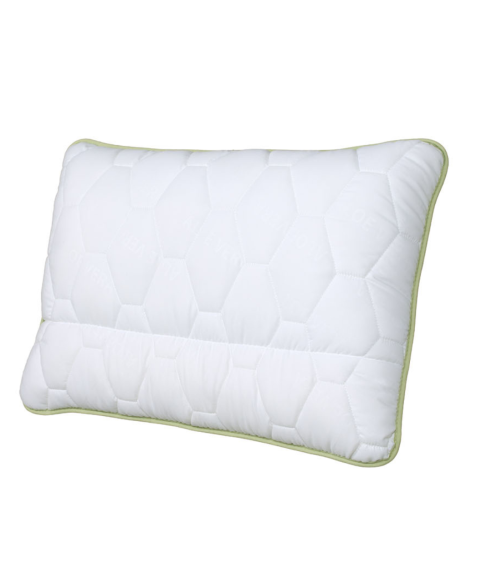
Ergonomic pillow „Aloe vera“
28,79€ 35,99€