
Why hair falls out — hormones, stress, sleep and how it all connects
Everyone loses hair. That is normal — an average of 50–100 strands per day is the physiological norm. But when significantly more starts being left on the brush, on the pillow or in the shower, and when this continues for weeks or months — that is already a signal that something is happening in the body or the environment.
The problem is that hair loss rarely has a single cause. Most often it is a combination of several factors acting simultaneously and reinforcing each other. And many of these factors are closely interconnected — hormones affect sleep, sleep affects stress, stress affects hormones. It is a closed loop that is important to understand before looking for a solution.
The hair growth cycle — why it is important to understand
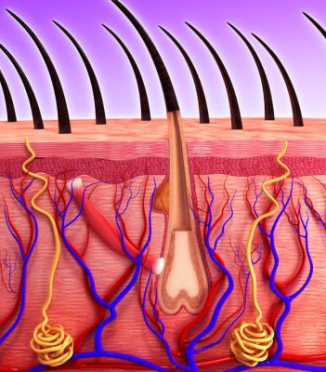
Before talking about causes, it is worth briefly understanding how hair grows. Each hair follicle goes through three phases:
Anagen phase — the active growth phase. Lasts 2–7 years. About 85–90% of all hair is currently in this phase.
Catagen phase — the transitional phase. Lasts 2–3 weeks. Hair growth stops.
Telogen phase — the resting phase. Lasts 3–4 months. At the end the hair falls out and the follicle begins a new cycle.
Why does this matter? Because many factors — stress, hormonal changes, sleep deprivation — can trigger what is called telogen effluvium. This means that too many follicles enter the telogen phase at once and after 2–4 months begin falling out intensively. This is why hair loss is often noticed not immediately after a stressful event, but months later.
Hormones and hair loss
Hormones are one of the most important regulators of hair growth, and their imbalance is the most common cause of hair loss — particularly in women.
Thyroid hormones
The thyroid gland regulates metabolism and has a direct impact on hair follicles. Both thyroid insufficiency (hypothyroidism) and excessive thyroid activity (hyperthyroidism) can cause diffuse hair loss.
Thyroid problems often occur alongside fatigue, weight changes, altered temperature sensitivity and sleep problems — yet another connection between hormones and sleep.
Androgens — DHT
Dihydrotestosterone (DHT) is a testosterone derivative that can miniaturise hair follicles — meaning the follicles become smaller and eventually stop producing visible hairs. This is the mechanism behind androgenetic alopecia — the most widespread form of hair loss in both men and women.
In women androgenetic alopecia often worsens during menopause, when oestrogen levels fall and the effect of androgens becomes more pronounced.
Oestrogen and progesterone
During pregnancy elevated oestrogen levels often give hair unusual thickness and shine — many hairs remain in the anagen phase longer than usual. After childbirth however oestrogen levels drop rapidly and all the hairs that "postponed" their fall begin falling out simultaneously. This is called postpartum hair loss and can look dramatic, but is usually temporary.
The same mechanism operates after stopping contraceptive pills or with other hormonal changes.
Cortisol — the stress hormone
Cortisol is the direct link between stress and hair loss. Chronic stress raises cortisol levels over time, which can disrupt hair follicle function and accelerate the transition to the telogen phase.
Stress and hair loss
Stress affects hair in two ways: through cortisol secretion (as mentioned) and through direct influence on hair follicles via the nervous system.
Acute stress
Strong one-off stress — bereavement, surgery, serious illness, severe emotional shock — can trigger telogen effluvium. Hair starts falling out more intensively roughly 6–12 weeks after the event and often lasts 3–6 months before stabilising.
Chronic stress
Chronic, unrelenting stress — work-related, relationship, financial — is more dangerous for hair because its effect is constant. Cortisol is permanently elevated, hair follicles are constantly affected and hair loss becomes chronic.
Stress, sleep and hair — a closed loop
This is where the direct link between stress and sleep begins. Stress disrupts sleep — hard to fall asleep, sleep is shallow, frequent waking. Sleep deprivation raises cortisol levels the next day. High cortisol further disrupts sleep the following night. And all of this simultaneously affects hair follicles.
Sleep and hair loss — the connection rarely discussed
Sleep is the time when the body regenerates. This applies to hair follicles too — the majority of cell division and growth occurs at night during sleep. Sleep deprivation disrupts this process directly.
Sleep deprivation and growth hormone
The majority of growth hormone (GH) is secreted during deep sleep. Growth hormone is directly linked to cell growth and renewal — this includes hair follicle function. Sleep deprivation reduces GH secretion which can negatively affect the rate of hair growth.
Sleep deprivation and inflammation
Chronic sleep deprivation triggers a systemic inflammatory response in the body. Chronic inflammation can affect hair follicles and accelerate their transition to the resting phase.
Circadian rhythms and hair growth
Hair follicles have their own circadian rhythm — a biological clock that regulates the cycle of growth and resting phases. A disrupted sleep schedule, night shift work or frequent time zone changes can disrupt this biological clock and negatively affect hair growth.
Other common causes of hair loss
Diet and nutritional deficiencies
Hair follicles are among the fastest dividing cells in the body — they require a constant supply of nutrients. The most commonly cited deficiencies associated with hair loss are iron deficiency as one of the most common causes of hair loss particularly in women, vitamin D deficiency which is very widespread in northern countries, and deficiency of zinc, biotin and B vitamins. Too strict a diet or calorie restriction also affects hair — the body reduces energy supply to "non-essential" functions and hair growth is one of the first to suffer.
Mechanical damage
This cause is discussed less often but is real. The daily friction between hair and the pillow surface accumulates night after night. A rough cotton or synthetic pillowcase can break hair and irritate follicles at the scalp. A silk pillowcase significantly reduces this friction — hair glides over the fabric rather than catching on it. Hair tied too tightly overnight, rough brushing of wet hair and hot hair styling tools also contribute to mechanical damage.
What can be done
Medical tests
If hair loss is intense or prolonged it is worth having blood tests for thyroid hormones, ferritin and iron, vitamin D, complete blood count and hormonal profile.
Improving sleep quality
Given the connection between sleep and hair, improving sleep quality is one of the most meaningful steps. A regular sleep schedule, cool bedroom and optimised sleep environment directly affect GH secretion and cortisol levels.
The choice of bedding also matters. A silk or satin pillowcase reduces mechanical hair damage at night — hair does not catch on the fabric, breaks less and does not slip from follicles. A natural breathable bedding selection can be found in the Savashome collection.
Stress management
Since cortisol is the direct enemy of hair follicles, stress management practices are not only psychological help but a direct solution to hair loss. Regular physical activity, meditation and breathing exercises lower cortisol levels.
Dietary correction
Make sure you are getting enough iron, vitamin D, zinc and protein. Hair follicles are protein-hungry — insufficient protein means slower hair growth.
When to seek a specialist
One should consult a dermatologist or trichologist when hair loss is sudden and intense, lasts longer than 6 months without obvious cause, when bald patches appear or when other symptoms such as itching, pain or skin changes on the scalp appear.
In summary
Hair loss is often a symptom rather than the condition itself. And it rarely has a single cause — most often it is a combination of hormones, stress and sleep quality that affect each other in a closed loop.
Understanding this connection is the first step. The second is systematically eliminating possible causes: checking hormonal and nutritional indicators, improving sleep quality, reducing stress and evaluating mechanical damage at night.
Hair loss is usually temporary and reversible once the cause is found and eliminated. But it requires time and patience — hair follicles respond to changes not immediately but after several months.
-cr-326x372.jpg "Silk hair ties: natural moisture for your hair")