How to choose children's bedding: healthy sleep and the right materials
How to Choose Children's Bedding: Safety, Materials and Sizes
When your little one falls asleep in their cot for the first time, parents want one thing – for them to sleep safely, comfortably and peacefully. But in shops the choice of bedding is so vast that it makes your head spin: cotton or microfibre? What size duvet? Is this fabric really safe for my child? In this article we answer all these questions simply and clearly.
Why Does Children's Bedding Differ from Adults'?
Many parents think it's enough to buy a smaller adult bedding set. However, it's not the same thing. Children's skin – especially in babies and young children – is much more sensitive and thinner than adults'. It reacts more easily to chemical dyes, synthetic fabrics and allergens. In addition, children move much more actively during sleep, sweat more intensively and their thermoregulation is not yet as developed as in adults.
This means that children's bedding must meet much higher requirements – not only aesthetically, but also in terms of safety and materials.
.jpg)
Safety First – What to Look Out For?
Certificates and Chemical Composition
The first thing to check – whether the bedding has the Oeko-Tex Standard 100 certificate. This international certificate guarantees that the fabric contains no harmful chemical substances, heavy metals, pesticides or formaldehyde. This is particularly important for babies and young children who spend up to 14 hours a day in bed.
No Small Parts
Children's bedding should not contain:
- Buttons and press studs on covers – babies can detach them and swallow them
- Long ribbons or strings – strangulation hazard
- Decorative elements that can come loose
Choose bedding with zips or buttons on the inside, so they are not in direct contact with the child's skin.
Filling Thickness and Weight
For babies under one year old, thick or heavy duvets are not recommended – they pose a danger. For younger babies, sleeping bags or thinner covers are more commonly used. For older children, light, thin duvets with minimal filling can be chosen.
Materials – Which is Best for Children's Bedding?
100% Cotton – the Best Choice
Cotton is the gold standard for children's bedding. It is:
- Natural and hypoallergenic – does not irritate sensitive skin
- Breathable – prevents the child from overheating
- Good at absorbing moisture – keeps dry during sweating
- Easy to wash at high temperatures – important for hygiene
- Long-lasting – will withstand dozens of washes without losing its properties
Particularly recommended is combed cotton – it is even softer and less prone to pilling.
Microfibre – a Practical Choice
Microfibre is also popular for children's bedding because of:
- An exceptionally soft surface
- Quick drying
- Wrinkle resistance
- Lower price
However, it is synthetic and therefore less breathable than cotton. If your child tends to overheat at night – it is better to choose cotton.
What to Avoid?
- Polyester blends with aggressive dyes – can irritate the skin
- Flannel for children who heat up quickly – a warm material suitable for colder regions or winter
- Untreated synthetics – can accumulate static electricity
Colours and Patterns – Not Just Aesthetics
Colour and patterns on children's bedding are not just a matter of looks. Research shows that overly bright, contrasting colours can overstimulate a child's nervous system and make it harder to fall asleep. Therefore we recommend:
- For babies: soft pastel colours – mint, cream, lavender
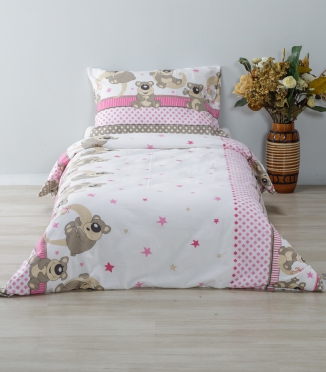
- For young children (2–5 years): playful patterns with animals, clouds or geometric shapes – but not too bright
- For older children: more is permitted – favourite characters, brighter colours, stylish patterns
Also pay attention to dye quality – bright colours should not fade after the first wash or stain hands.
Care – How to Maintain Quality for Longer?
Children's bedding is washed much more frequently than adults' – on average every 5–7 days, and pillowcases even more often. Here are some tips:
- Wash at 40–60°C – this kills bacteria and dust mites
- Use hypoallergenic detergents – without fragrances and aggressive chemicals
- Dry naturally or in a dryer at low temperature
- Change pillowcases every 3–5 days – especially if the child sweats
- Always wash before first use – you will remove dust particles that arose during production
Most Common Parental Mistakes When Choosing Children's Bedding
1. Buying too cheap an option. The cheapest bedding is often made from low-quality synthetic fabrics with aggressive dyes. This can cause skin irritation.
2. Ignoring certificates. The Oeko-Tex certificate is not a luxury feature – it is a necessity for children's bedding.
3. Choosing duvets that are too thick. Especially for babies – this can create an overheating risk.
4. Not measuring the bed before buying. The wrong size = uncomfortable sleep and constantly slipping bedding.
5. Forgetting about the pillow. Many parents focus on the duvet but forget that the right pillow is equally important for children's spinal and neck health.
Summary
Choosing children's bedding is an investment in their health, safety and sleep quality. The best material – 100% cotton with Oeko-Tex certification, the right size according to the child's bed and age, and regular care. Colours and patterns are the sweet dessert, but safety and quality must always come first.
At Savashome.com you will find children's bedding made from 100% cotton, sewn in Lithuania, meeting the highest quality requirements. Choose peaceful sleep for your child – they deserve it.