
Why do you get dandruff — and is your pillowcase really to blame?
You use a specialist anti-dandruff shampoo, follow all the advice — and still see white flakes on the pillow in the morning. The problem may not be your hair or your shampoo. It could be under your head — in what you sleep on for 8 hours every night.
What dandruff actually is
Dandruff is not a hygiene problem. It is the result of the skin's renewal process: the scalp, like all skin on the body, constantly renews its cells. Under normal conditions this process goes unnoticed. But when it accelerates — due to fungus, overly dry air, irritation or inflammation — the renewing cells accumulate and become visible as white or yellowish flakes.
The three most common causes of dandruff are seborrhoeic dermatitis, the most common cause, a chronic skin inflammation linked to the Malassezia fungus which naturally lives on the skin but under certain conditions begins to multiply excessively. A moist, warm environment is the perfect breeding ground. Overly dry skin produces fine, white flakes that typically appear in winter when the air is dry — the scalp feels tight or itchy. Contact dermatitis is a skin reaction to something one constantly comes into contact with, which may be shampoo, conditioner, hair products — or the fabric one sleeps on every night.
How a pillowcase can cause or worsen dandruff
Bacteria and fungus on the fabric
The pillowcase collects sweat, skin oils, dead skin cells and residues of hair products overnight. After a few days this combination creates an environment in which bacteria and fungi — including the dandruff-associated Malassezia — multiply actively. The following night all of this returns directly onto your scalp.
Researchers have found that a pillowcase left unchanged for a week can harbour more bacteria than a toilet seat. And that is the surface your scalp is in contact with for 7–8 hours.
Rough fabric irritates the skin
Synthetic and low-quality cotton fabrics have an uneven surface structure. At night, when turning over, the scalp constantly rubs against this surface. This micro-friction irritates sensitive scalp skin, damages the skin's barrier function and stimulates inflammation that can accelerate skin renewal and cause dandruff.
Moisture and heat
Synthetic fabrics do not allow moisture to disperse — it accumulates at the surface of the scalp. A warm and moist environment is optimal for the growth of Malassezia fungus. If you notice that dandruff worsens in summer or after nights with a thick duvet, moisture may be one of the factors.
Fabric softeners and chemicals
Some ingredients in detergents or fabric softeners can irritate sensitive scalp skin. This is not an allergic reaction in the classic sense — more often it is a chronic, subtle irritation that is difficult to connect to a specific cause because it builds up gradually.
Which fabric is best for people with sensitive scalp skin
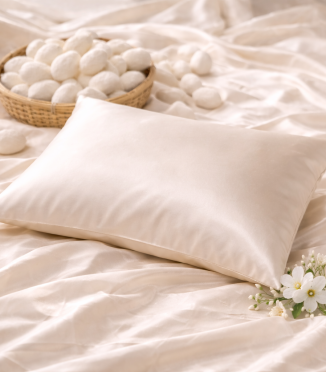
Silk — the best choice
The surface of silk is exceptionally smooth — it creates no friction and allows moisture to disperse. Silk has naturally antibacterial properties thanks to the sericin protein, which inhibits the growth of bacteria and fungi. This is not a marketing claim — it is a chemical fact about silk.
A silk pillowcase is the most expensive but most effective alternative for reducing irritation of sensitive scalp skin. Dermatologists recommend it not only for dandruff but also for atopic dermatitis and sensitive skin.
Cotton and percale — a good everyday choice
Tightly woven percale or a high-TC cotton pillowcase is significantly smoother than standard satin or synthetic fabrics. It breathes, does not allow moisture to accumulate and is of natural origin — three important criteria for people with sensitive scalp skin.
What to avoid
Polyester and synthetic blends heat up, accumulate moisture and cause friction damage. Also avoid old, faded pillowcases — their structure becomes rougher after many washes, meaning more irritation.
How often to change the pillowcase
If you are fighting dandruff, change it every 2–3 days. This sounds like a lot, but in practice it means having 3–4 spare pillowcases to rotate. If the scalp is healthy and causing no problems, once a week is the minimum.
Wash at 60 °C — only this temperature effectively destroys bacteria and fungi. Do not use fabric softener — it can leave chemical residues on the fabric.
Other factors that are often forgotten
Residues of hair products, conditioners, serums and protective sprays transfer onto the pillowcase and return to the scalp the following night. If you use many hair products it is particularly important to change the pillowcase more frequently.
Do not wash your hair immediately before going to bed — wet hair on the pillow creates a moist environment that encourages fungal growth both on the fabric and on the scalp.
Check your shampoo — some anti-dandruff shampoos work in the short term but dry out the scalp over time. If you have been using them for more than a month without improvement it may be time to change the product.
Stress is one of the most common triggers for dandruff flare-ups because it directly affects the immune system and the skin's barrier function. This explains why dandruff often appears during stressful periods in life.
When to see a doctor
If dandruff does not clear up within 4–6 weeks after changing the pillowcase and care routine, it is worth consulting a dermatologist. Particularly if the scalp is red, inflamed or irritated, the dandruff is yellow and greasy which may indicate a more severe form of seborrhoeic dermatitis, the itching is intense and disrupts sleep, or dandruff appears on the eyebrows, temples or chest.
In summary
Dandruff has many causes — and the pillowcase can genuinely be one of them, or a factor that worsens an existing problem. Bacterial accumulation, moisture, rough fabric structure and chemical residues are real sources of irritation acting for 8 hours every night.
The simplest first step is to change the pillowcase more frequently and choose smoother, natural fabrics. This does not cost much but can significantly reduce scalp irritation — especially if the other causes of dandruff are already being addressed with the right shampoo and care.
%20(1680%20x%202000%20px)%20(1680%20x%202000%20px)%20(1800%20x%201800%20px)-cr-326x372.png "Why a Silk Pillowcase Is Called a Beauty Treatment During Sleep")